Conversion Rate Optimization: A Practical Guide to Getting More From the Traffic You Already Have
For most companies, the natural reaction to a stagnant growth curve is to assume they need more traffic. After all, more visitors equal more sales, right? The problem is that traffic is expensive and, for most websites, the lion’s share of that traffic is doing nothing at all. For example, Statista’s benchmarking data shows that the average website only converts about 1.7% of visitors, meaning that, for every 1,000 people who visit your page, only 17 take the action you want them to take.
Conversion rate optimization is the discipline focused on understanding and reducing this wasted opportunity. In other words, CRO is about deriving the maximum value from the traffic you already have.
This article explains what conversion rate optimization is, how it differs from SEO and UX, what a CRO strategy involves, how the CRO process works, where B2B websites typically lose conversions, which tools and metrics can support the process, what CRO can cost, and which common mistakes can waste time and budget.
What Is Conversion Rate Optimization?
Conversion rate optimization is a systematic process of improving your website’s conversion rate. In other words, you try to get more visitors to take a specific action: fill out a demo request form, ask for a quote, begin a free trial, or make a purchase.
The math is straightforward:
Conversion rate = (Number of conversions ÷ Number of visitors) × 100
If your website gets 5,000 people a month and gets you 75 form fills that means 1.5% of your visitors are converting. If you can improve that number to 2.5%, you’ve just created another 50 leads for your business, with the exact same amount of traffic.
This, in essence, is the economic foundation of a CRO program. And yet, the definition is a bit more involved than it appears. The crucial element is the systematic process that underlies the work.
There is no magical headline or mystical call-to-action button that automatically converts better. A CRO professional forms a hypothesis about why users behave in a particular way, tests it, and uses the results to determine whether the change actually improved performance.
The goal isn’t simply to make a page look better. It’s to understand user behavior, identify friction or missed opportunities, make an evidence-based change, and measure what happens next.

CRO vs. SEO vs. UX vs. "Website Optimization": Untangling the Overlap
| Discipline | Core question it answers | Primary output |
|---|---|---|
| SEO | Can the right people find this page in search? | Traffic and visibility |
| UX design | Is this experience intuitive and pleasant to use? | Usability, satisfaction |
| CRO | Of the people who arrive, how many take action, and why don’t the rest? | Conversion rate, revenue per visitor |
| General website optimization | Umbrella term covering speed, accessibility, mobile performance, design polish | Overall site quality |

What a "Good" Conversion Rate Actually Looks Like
There’s no magic number since any source that tries to establish one universal benchmark is oversimplifying a set of highly disparate variables, including industry, traffic source, offer, audience intent, device, and whether you’re looking at a homepage, blog post, or landing page.
With that said, here are a few helpful data points:
- The average conversion rate across all industries and traffic types is somewhere around 1.7% based on Statista’s data.
- Landing pages, which typically focus on a single goal and minimize distractions, tend to have higher conversion rates than general website pages. Some industry benchmarks place average landing-page conversion rates in the 6–7% range, while some individual pages can achieve much higher rates.
- According to Optimizely, which has run more than 127,000 experiments and published some of its results, only a portion of tests produce statistically significant positive results. This reinforces an important CRO principle: an individual test idea is not a silver bullet. The broader process of testing, learning, and iterating is what creates improvement over time.
The point is, you likely shouldn’t be comparing yourself to any one of these numbers. Establish your own baseline and look at meaningful improvements over time.
Your conversion rate should also be interpreted in context. A visitor arriving from a high-intent search query may behave very differently from someone arriving through a broad awareness campaign. Likewise, a free-demo form, ecommerce checkout, newsletter signup, and sales inquiry are different conversion goals and should not automatically be judged against the same benchmark.
Establishing Conversion Goals and CRO Metrics
Before optimizing a page, you need to know what a conversion actually means for your business.
A conversion could be:
- A completed purchase
- A demo request
- A quote request
- A free-trial signup
- A completed lead form
- A phone call
- A consultation booking
These are examples of primary conversion goals. You can also track smaller actions, often called micro-conversions, such as clicking a CTA, starting a form, viewing a pricing page, or downloading a resource.
The important thing is to distinguish between an action that indicates progress and the business outcome you’re ultimately trying to achieve.
Common CRO metrics can include:
- Conversion rate
- Form completion rate
- CTA click-through rate
- Funnel drop-off rate
- Revenue per visitor
- Lead-to-customer rate
The exact metrics you use should depend on your conversion goal and sales funnel. Tracking more numbers does not automatically produce better CRO decisions. The useful metrics are the ones that help you understand where users are progressing, where they are dropping off, and whether an optimization is improving the outcome that matters.

What Is a CRO Strategy?
A CRO strategy is the framework a business uses to systematically identify conversion problems, prioritize opportunities, test changes, and learn from the results.
A practical CRO strategy can be thought of as:
Goal → Data → Problem → Hypothesis → Prioritization → Test → Measurement → Iteration
This prevents CRO from becoming a collection of random website changes.
Instead of asking, “What should we change on the page?”, the better question is:
“What evidence tells us there is a problem, what do we think is causing it, and how can we test that assumption?”
The Conversion Rate Optimization Process
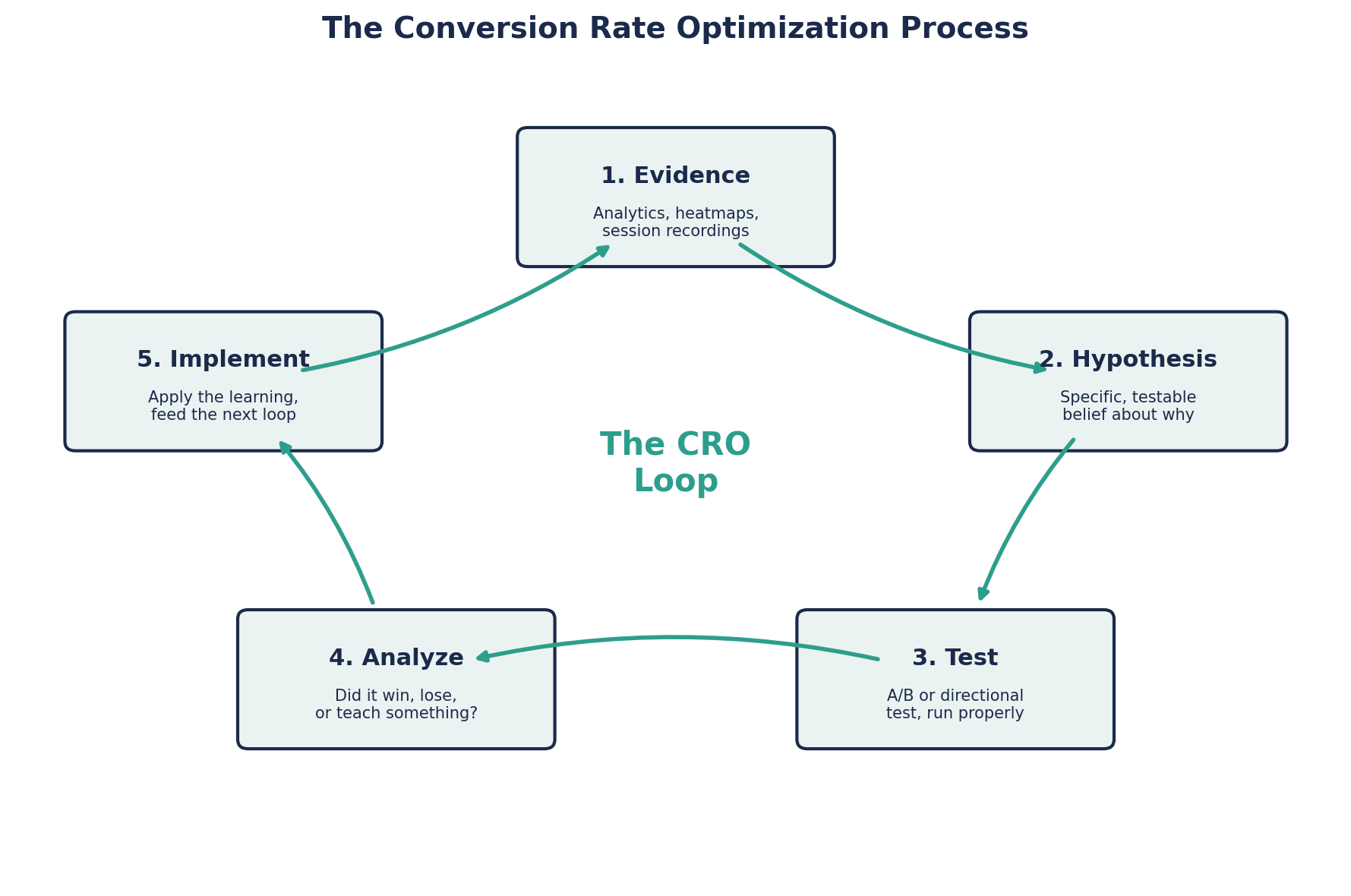
A CRO program that works is a loop, not a one-time project. Here’s how the loop runs in practice.
1. Audit Your Funnel and Establish One Goal
Before doing any testing, analyze your existing sales funnel and find one problem area that you want to address.
For a B2B website, your sales funnel probably extends somewhere between the moment a prospect lands on your service page and the point they fill out an inquiry or lead form on your website.
To begin the loop, analyze your analytics and identify the pages in your funnel with a large volume of visitors and a poor conversion rate. These pages can present a strong opportunity to improve your bottom line because there’s no need to drive more traffic to your website if you can get more value from the visitors you already have.
2. Collect Evidence, Not Intuition
This step is all too often skipped by well-meaning but misguided CRO practitioners.
Your intuition is not evidence.
The fact that you think your form is too long is not evidence. Evidence would be a session recording showing users repeatedly abandoning the page while trying to complete a particular field, or analytics showing a significant drop-off at that step.
Make sure your hypothesis has three elements:
- Observed behavior: what’s happening now
- Proposed improvement: what you’re going to test
- Expected result: what you expect the change to improve
An example of a properly formulated hypothesis would be:
“Because 40% of our visitors abandon our quote form at the step where they have to enter their phone number, removing the phone number field will increase the conversion rate.”
Evidence can take several forms:
Quantitative: analytics, funnel conversion rates, page-level conversion rates, traffic sources, and drop-off data.
Qualitative: heatmaps, scroll-depth reports, session recordings, and usability observations.
Primary research: exit-intent surveys, sales-team feedback, customer-support logs, interviews, and direct customer feedback.
The purpose of gathering this evidence is not to collect data for its own sake. It is to understand what users are doing and why they may be struggling.
3. Formulate a Hypothesis
Once you’ve identified a problem and gathered evidence, turn that information into a testable hypothesis.
A useful structure is:
Because [observed behavior], changing [specific element] should result in [expected outcome].
For example, if session recordings show visitors scrolling past your demo-request CTA without clicking, the hypothesis could be that moving the CTA above the fold, closer to where visitors are already reading, will increase click-through rate.
The hypothesis gives the test a purpose. Without it, you’re simply changing things and hoping they perform better.
4. Prioritize
You will always have more hypotheses than time or resources to test them all.
A simple prioritization framework, such as ICE, can help you evaluate ideas based on factors such as impact, confidence, and ease of implementation.
The prioritization should be handled by people with enough context about the CRO program and business goals. Otherwise, teams may naturally prioritize what’s easiest to implement rather than what has the strongest potential impact.
For example, launching a small social campaign may be easier than improving a complicated website experience, but ease of implementation alone shouldn’t determine which CRO opportunity gets attention.
5. Run the Test and Measure the Results
When an A/B test is appropriate, split your traffic between the control and the variation and let the test run long enough to collect enough data for a reasonable conclusion.
This means that, for many B2B websites, a test may need to run for several weeks before you can determine whether the result provides enough evidence to act on.
One of the most common pitfalls in CRO is stopping a test too early because one variation initially appears to be winning.
Statistical significance is useful because it helps you distinguish a potentially meaningful result from random variation. However, statistical significance should be considered alongside sample size, test duration, conversion volume, and the practical importance of the result.
6. Implement, Document, and Iterate
No matter the result of your test, document your findings for future reference.
If your test variation failed, it still contains valuable insight about your audience that you can use to inform future tests.
Over time, these documented experiments create a knowledge base about what your audience responds to, what creates friction, and which assumptions were proven wrong.
CRO Tools: What Do You Actually Need?
CRO does not depend on one specific tool. Different tools help answer different questions about user behavior and conversion performance.
Common categories include:
- Analytics tools: show traffic, conversion rates, user journeys, and funnel performance.
- Heatmap tools: show where users click, scroll, and interact with a page.
- Session-recording tools: help you observe how individual users navigate and interact with a website.
- A/B testing platforms: allow teams to compare different versions of a page or element.
- Survey and feedback tools: collect direct information from users about problems, objections, and expectations.
The tool itself isn’t the optimization strategy. A sophisticated platform cannot compensate for a weak hypothesis or poor-quality evidence.
CRO without Big Traffic: What Low-Volume B2B Sites Should Do Instead
One of the things that many CRO guides overlook is that formal testing can be difficult at low traffic volumes. Most B2B sites, especially those selling expensive SaaS or other services, have a problem with traffic being too small to detect a meaningful difference in conversion rate between the control and variation within a reasonable timeframe.
Now, that does not mean that you cannot do anything about your conversion rate. It just means that you have to approach testing differently.
First and foremost, you may need to rely less on formal A/B testing and make greater use of qualitative evidence. Session recordings and five-second tests can reveal obvious problems with a page without requiring a statistically significant A/B test.
You can also use sequential changes when a traditional split test is not practical. Rather than splitting limited traffic between two variations, you can make a change, allow the metric to stabilize, and compare performance with the previous version. The trade-off is that it becomes harder to attribute the result to one specific change.
It is also important to prioritize changes based on how much confidence you have in the problem and the proposed solution. If you are dealing with an obvious usability issue, fixing it may be more useful than waiting for a formal test to produce enough data.
On the other hand, when the outcome is uncertain and the potential impact is significant, gathering more evidence before implementation can reduce the risk of making the wrong change.
Finally, when traffic is very limited, you may sometimes need to group related changes rather than running a separate test for every small adjustment. The trade-off is that batching changes makes it harder to determine which individual change caused the result.

Where B2B Sites Typically Lose the Most Conversions
Homepage
For a B2B buyer who landed on the website without a specific landing page in mind, the homepage is the place to get answers to the questions:
- What do you do?
- Who is it for?
- What should I do next?
A homepage drowning in all the services offered with no clear guidance on what to do next can drive away confused but interested visitors.
Service and Landing Pages
Service and landing pages should be focused on a specific offer and a clear next step.
A services page listing SEO, PPC, web design, and content writing with the same generic “Contact Us” button on every page may fail to address the specific intent of visitors interested in each service.
The page should make the offer clear, explain its value, address relevant objections, and give the visitor an obvious next step.
Lead Capture Forms
The more fields a visitor has to fill in, the more potential friction you introduce.
Asking a B2B prospect to provide their phone number, company size, budget expectations, and other details on their first visit may create unnecessary resistance before you’ve established enough value.
A shorter form combined with a follow-up email or phone call can sometimes reduce that initial friction while still allowing the sales team to gather additional information later.
CTAs
Buttons with vague copy like “Submit” or “Learn More” may not give a B2B buyer enough context about what happens next.
CTA buttons on landing pages can use more specific, lower-friction instructions such as:
- “See Pricing”
- “Get a Free Audit”
- “Book a 15-Minute Call”
The right CTA depends on the visitor’s intent, the offer, and the stage of the buying process. There is no universal CTA phrase that automatically converts better.

Common CRO Mistakes That Waste Budget
- Testing without a hypothesis. Tweaking something that “might be better” is not an optimization strategy. It is a change without a clear learning objective.
- Quitting a test early. If you declare a winner as soon as it gains ground and kill a losing variation too soon, you’re more likely to mistake temporary variation for a reliable result.
- Following best practices blindly. Tactics that worked for other businesses — say, a tactic that drove impulse purchases for an ecommerce store — can have little or even negative value for a B2B supplier with a much longer sales cycle. Test ideas in your own context rather than assuming someone else’s result will transfer directly.
- Fixing traffic that isn’t going to convert. If your advertising campaigns and SEO work are attracting the wrong kinds of visitors, you won’t get good results by A/B testing every element of the page. You may need to rethink targeting and traffic quality first.
- Stopping after a single 20% win. An individual test result does not mean the optimization process is finished. Continue monitoring performance and use the result to inform future experiments.
How Much Does Conversion Rate Optimization Cost?
There is no hard-and-fast answer, and if someone gives you one universal number, you should ask what scope of work and traffic volume that estimate is based on.
There are a few variables that tend to influence CRO costs:
- Traffic volume: Higher-traffic sites can generally collect test data faster, allowing more experiments within a given period.
- Scope: A single landing-page review and test cycle will cost considerably less than an ongoing CRO campaign covering the homepage, pricing page, lead forms, and other parts of the funnel.
- Tooling: Behavioral analytics, testing platforms, and survey tools can add software costs on top of agency, freelancer, or internal team costs.
- DIY versus managed: Doing CRO yourself can reduce direct service costs but requires internal time, analysis, testing, implementation, and documentation.
Instead of thinking only in terms of a fixed CRO budget, start with your traffic volume, conversion goals, highest-value pages, and business objectives. Then determine how much testing and analysis is realistic for those conditions.

CRO and SEO: Why They Work Better Planned Together
SEO buys you visits; CRO determines what those visits are worth to you.
Trying to do both independently can create a situation where you have more traffic than ever before but little overall increase in revenue because the pages you’ve worked on aren’t converting visitors into customers.
The better approach is to consider both disciplines as a connected effort.
When planning pieces of content or landing pages, determine what conversion goal they will have from the beginning instead of appending a vague call to action to whatever text you wrote.
The same goes for CTAs and forms. Their surrounding context and copy should complement the intent of the visitor who arrived from the linked page rather than presenting a generic message.
For example:
Search intent → relevant content → relevant landing page → clear value proposition → appropriate CTA → conversion
Sharing analytics between SEO and CRO teams can also reveal opportunities. Pages with strong traffic but weak conversion rates may deserve CRO attention, while pages that perform well can provide useful patterns for other landing pages and content assets.
SEO and CRO therefore address different stages of the same journey: SEO helps the right people find you, while CRO helps you understand and improve what happens after they arrive.
The Bottom Line
Conversion rate optimization isn’t about hunches or simply copying what other companies have done. It’s about a systematic process that can be applied again and again.
Gather evidence, identify a hypothesis, prioritize the opportunity, test it appropriately, and implement or reject the change based on what you learn.
Start with the page that represents a meaningful opportunity, identify a specific problem supported by evidence, and test a focused hypothesis before moving on to the next one.
Over time, this process creates a deeper understanding of your audience and helps your business make better use of the traffic it already receives.